Wednesday, September 7, 2011

Youth in the Service of Age


From the desk 
Conservator at the 
Royal BC Museum


David Douglas was a hard-working Scottish botanist.   When he died, aged 35, he had introduced about 250 North American plants to British gardeners.   In addition to the Douglas Fir, he described 7,000 of the 92,000 plants known to botanists in the early 19th century.  Over eighty plant and animals have douglasii in their scientific names.


Douglas' often requested book of sketches alongside a Pseudotsuga menziesii cone 

He travelled to the Pacific Northwest in 1824 and 1830.  His Book of Sketch maps of a Journey from the Junction of the Columbia and Okanogan Rivers to Quesnel and North, April to May 1833 is in the BC Archives and frequent requests are made by researchers who wish to view or photograph the manuscript maps.  Unfortunately the book is in very poor condition; it is too delicate to travel and photography is difficult because of the damaged binding.  The 25 single-sided pages containing the maps sketched in iron gall ink are relatively stable at the moment, but iron gall ink is notoriously destructive to paper.
We are very fortunate this summer to have Emilie van der Hoorn, an intern from the University of Northumbria (UK) working with paper conservator Betty Walsh.   Emilie has a particular interest in iron gall inks and she tested the pages with Iron Indicator Paper developed by the Netherlands Institute for Cultural Heritage.  These revealed that there are loose Fe2+ ions present which will catalyze the degradation of the cellulose; in time the ink will eat through the paper. 
She has proposed that the iron gall ink be treated soon to preserve the relatively good condition of the sketches, and that the remaining pages of the book be washed and de-acidified.  There are two options for treatment.  The least invasive would be to interleave sheets of gelatin impregnated alkaline paper between the inked pages.  These would neutralize acids to a pH at which the gelatin could complex the Fe2+ ions preventing migration of the corroding ink to facing pages, but not preventing acids and ions embedded in the paper from degrading further.  Alternately the pages could be treated with a calcium-phytate method.  Developed by the Rijksdienst voor het Cultureel Erfgoed in the Netherlands, this would leave the paper cleaner, probably more supple, deacidified, and with an alkali reserve to counter future acid buildup; ink corrosion would not continue.  The book would have to be taken apart, and rebound after the treatment was complete, however the binding is fairly ordinary and, once apart, the manuscript maps could be better photographed for use by researchers. 

It is always a difficult decision to disassemble an artifact.  Although conservators aim for reversibility in their treatments, in many cases this is impractical.  Conservators also tend to be … conservative, unwilling to experiment with treatments that have not stood the test of time; there are many cases where doing nothing has caused less damage than elaborate “improvements”.  However, the problems with untreated iron gall ink are well known.  

Interns challenge us with their questions, inspire us with fresh ideas from their recent studies, and galvanize us with their youthful energy.  Because of the crush of other projects, treatment of the Douglas Sketchbook will happen after Emilie has returned to her studies, but in the meantime we have all benefitted.  Emilie examined, analyzed and articulated the treatment of a valuable artifact, the Archives received the perspective of two of the leading schools of paper conservation, and the manuscript maps of David Douglas are poised to illuminate future research.

Friday, August 26, 2011

Scavenger hunt

From the desk of
 Sean Rodman

Strategic Partnerships
Manager 
at the
Royal BC Museum


School hasn't started yet and, as I am writing this, it's raining here in Victoria.  So, what to do with the kids?  Come down to the Royal BC Museum and go on a scavenger hunt! I've taken 5 mystery photos, and attached a few clues to help you out.


Can you figure out where I took these pictures in our galleries?

1)

From his perch high up on the old stone wall,
This raven keeps guard,

Over those entering our hall.

2)
Boots made to order, 
While you listen to the sounds,
All around you in Canada's oldest Chinatown.
3)

Barrels by the shore, all ready to go.
Have a drink in the tavern,
While the sea breezes blow

4)


His home is not in the sky, not on the land.
This whale flies through the air,
- so give him a hand!

5)
It looks like a dino, but don't get it wrong.
This old horse ate grass,

All day long!

6)

Last but not least - a present for you!
Bonus points if you can... 
Identify the poo!

Friday, August 19, 2011

An Acquired Taste

from the desk of
Genevieve Weber

Archivist
Collections, Research
and Access Services
 

Royal BC Museu


People often ask me what my favourite part of my job is.  The answer is easy: looking through the records.  I review new acquisitions, decide whether they fit with our mandate, and write proposals recommending whether we should add them to our collections or send them on to a more appropriate repository.  So, a big part of my job is looking through records – before anyone else!  Even better!
The BC Archives collects records relating to the political, business, and social history of British Columbia.  Often people and companies want to donate their records to the Archives, but before we accept them there are a number of things to consider.  For example, do we already have related records?  Were the records created in the province?  Was the creator from the province or did s/he spend a significant amount of time here?  Do the records provide evidence of activities, people, and life in the province?
As I research the records to determine these things, I often find interesting extras tucked in amongst the documents.  The archives generally accepts paper, photographic, audio-visual, cartographic and electronic records, but often other types of objects are included in an acquisition.  When this happens, I have a choice to make: the archives can keep the object and consider it a record; the object can be offered to another part of the museum, such as the Human History department and transferred accordingly; or it can be returned to the donor if it is considered to be irrelevant to the rest of the records.  In the past few months we have found some fascinating items:
  • -      Driftwood painted with the image of a seagull (kept with the records of the B.C. Indian Arts and Welfare Society fonds)
  •         A sad iron from the 19th century (to be returned to the donor as the provenance is unknown and it is unrelated to the records)
  • -      A lock of hair (re-housed and kept with the records – as it was with a letter it is considered to be a part of the correspondence)
  • -      Pince-nez (armless eyeglasses) belonging to a former BC Premier (transferred to Human History)
  • -      A 19th century cash box, used to store the diaries of a former BC Premier (transferred to Human History)
Example of a 19th century
sad iron

Cash box containing: 
diaries and pince-nez case
RBCM 2011.156
Sometimes I determine that the records would be better suited to another institution.  The BC Archives communicates with museums and archives throughout the province and the country to ensure that records are being stored in the most suitable place possible.  This spring we were offered a group of records that I determined would better fit the mandate of the Japanese Canadian National Museum in Burnaby.  The records, although created in BC, were related to a federal activity and therefore would be more suitable in a national institution.  The donor agreed, and the JCNM was thrilled to be the recipient of the donation.  Likewise, a colleague recently called me from Arizona to offer us some records that had been created in BC and which he felt were completely out of his repository’s scope but may fit in ours. 
Once I have determined that the records are related to BC and fit our mandate, I write a proposal to the Collections Committee, which has to approve each new acquisition before it can be added to the collection.  The proposal is jointly written by an archivist and a conservator.  For each item or group of records offered to the Archives, a conservator must ascertain the state of the records.  As the majority of records are paper, the main concerns are mold, bleeding ink, rust from staples or paperclips, disintegrations, etc.  However, there may also be a concern about “red rot”, something that happens to leather book covers, or photographic emulsion peeling back from the images.  Audio-visual records have their own set of conservation issues. 
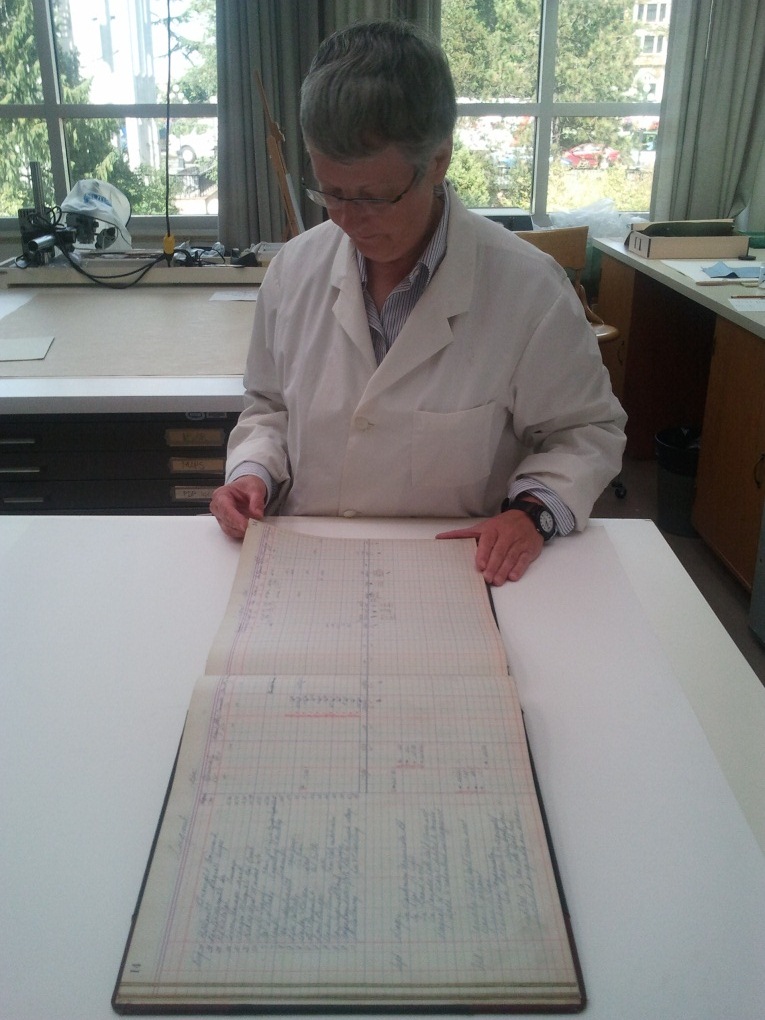
Archival Conservator Betty Walsh
examining a registry that is part of
a new acquisition

Recently acquired records vary in scope: registers of mining company shareholders; personal photograph albums created by a Victoria teacher and administrator; the private records of politicians from the last two centuries; sketch books with images by a magazine illustrator; corporate records of BC companies and organizations; and commercial photographs taken of events and places around the province.  With so many intriguing records to examine I am constantly setting myself strict timelines – otherwise I would be at risk of spending all my time reading old letters and looking at pictures but never getting any work done! 
Do you like to look through old stuff?  I would love to hear your stories about interesting things you have found – perhaps in a relative’s home or even your own attic!

Monday, August 15, 2011

Beetlemania


From the desk of Kelly Sendall, 
Manager of Natural History
Royal BC Museum

The practice of preparing specimens for a museum's reference collection is by and large standard the world over. Chances are that a flying squirrel specimen collected for the museum in Paraguay would be prepared in the same way a flying squirrel specimen is prepared here at the Royal BC Museum. Most natural history museums, at least those large enough to have a preparator, will have a living colony of scavengers. I'm talking about beetle colonies maintained to help clean and prepare skeletons of birds and mammals. These are dermestid beetles, sometimes referred to as carpet or larder beetles, and are commonly found in the wild in most parts of the world. Those used most often by museums belong to the species Dermestes maculatus (right)

One of two cabinets at the museum
containing one colony each.
The beetle colonies are kept in a secure and beetle-tight room so that there is little chance any escapees can make their way back into the museum collection. This is important as the "untrained" beetles will indiscriminately munch away on a variety of natural materials not intended for them, therefore,  the door to the room containing the colonies and the cabinets themselves are sealed from the exterior with plastic pipe or ribbon gaskets.
A colony busy munching on a raptor skeleton
for the reference collection.
Ribs and breastbone are visible in the upper right
of the picture.
The beetles are very thorough at cleaning all muscle and connective tissue from carcasses and, for that reason, very important in helping out with museum specimen preparation. Although colonies can be started from wild caught beetles they may be carrying uninvited guests such as mites which compromise their ability to survive. Colonies may also be purchased.  The museum is fortunate to be able to share efforts with the University of Victoria in keeping colonies viable between the two institutions.
Here are 18 bats just dropped off for a
beetle cleaning. After a couple of weeks
these will be 18 beautifully cleaned skeletons.

Some prepared skeletons of
northern flying squirrels (Glaucomys sabrinus)
ready for the collection.

The fine details of the bones are now visible
with virtually no damage to even
the tiniest of bones.


Being able to examine the fine details and accurately measure features or lengths of bones is often very important in identifying smaller species of mammals. The single bone in the small vial (pictured below) is only about 5mm long.

baculum from specimen of Glaucomys sabrinus

Once all the beetle work is done the skeleton
is reunited with the rest of the specimen
in the reference collection
.

If you would like to read more about these beetles as preparators in natural history museums please see:

Friday, August 5, 2011

Kids Discover Emily


From the desk of Kim Gough, Program Developer at the Royal BC Museum


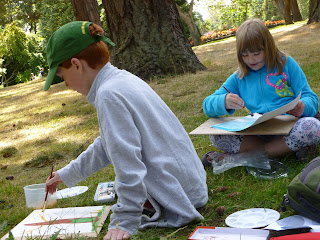
Camp Inside-Out at the Royal BC Museum lets children between the ages of 8 and 10 experience a week at the museum. Kids get to visit with curators, go behind the scenes and go into the galleries early. This year they are also learning about Canada’s greatest woman artist, Emily Carr.


Jessie Jakumeit is one of this year’s camp coordinators. An artist herself, she has loved Emily Carr since she was a young girl. Most of the kids in camp know about Emily Carr, but unlike Jessie, they aren’t all fans of her art – at least when the week starts. They do like to hear stories about her – especially when it includes anecdotes about her pets.


During the camp, Jessie tries to emphasize the process of making art rather than the finished product itself. Although kids like to get their hands dirty, and have big imaginations, they can struggle with knowing where to start. Following the philosophy of John Cage who says “begin anywhere”, Jessie leads the kids in some simple warm up exercises like drawing a straight line down the page and drawing circles that get smaller and smaller as you go.


Once the kids are warmed up they get to experiment with all types of mediums and formats. One of Jessie’s goals is to expose the young campers to a variety of new materials. In addition to crayons and markers, kids try water colours, tempera, charcoal, ink and even making art with rocks.


One thing that surprises Jessie is the amount of direction that they want; she finds that she needs to demonstrate each art activity for them. After a general demonstration, she visits each artist with her own sketchbook so she can answer their questions in a visual way.


Making art and learning about Emily Carr is just part of this year’s camp, and the kids enjoy the variety of activities. The art is highlighted at the end of the week when their parents are invited to the museum and the kids proudly show them their art work displayed in the gallery.


By the end of the week the campers know a lot more about how the museum works and about the people who work there. And if they haven’t all learned to love Emily they have learned to recognize that rather than depicting a realistic scene Emily was depicting feelings and emotions in her art. As Emily once said, “It's all the unwordable things one wants to write about, just as it's all the unformable things one wants to paint – essence.”

Wednesday, July 27, 2011

The Good Host


From the desk of Tim Willis, 
Director of Exhibitions 
& Visitor Experience 
Royal BC Museum

A terrific cashier assisted us when we arrived... What a marvelous 'front desk' persona he brings to his job. His manner was very friendly, he was helpful …You must be so proud of staff like him.  For visiting Aussies - what a great guy and what a magnificent museum!
                                            ~ A museum visitor from Australia
One could not ask for more than that as a first impression. I’m intrigued by the importance of positive (and negative) human interaction in shaping a memorable visitor experience.
As a child, I have a memory of visiting a place called Cheddar Gorge in England.  The caverns at Cheddar are spectacular - but what I recall most clearly is one thing: the Guide standing with his hand out (for tips!) at the end of our tour.  This unseemly act has stuck with me for 40 years.
We have clearly articulated that providing superb service as a priority for our organisation. For us, it’s a both business consideration and a critical aspect of shaping an enjoyable visitor experience. It’s also personal. I think we understand that when someone comes to our place, we want to be gracious hosts.
And to that end, we have created a Visitor Service Team made up of representatives of all parts of the organisation and our business partners who help us run Royal BC Museum – the Friends Foundation, the Café, and the magnificent IMAX Theatre. The team has done some great work in sorting out some longstanding irritants that got in the way of good service. They have also shaped a Service Philosophy [see below] to which we have all committed.

Our latest service winner – Venus Orance
Manager of the Museum Café
posing with the magnificent "Service Staff"
The other part to our initiative concerns awareness and training. We want to foster a “culture of great visitor service”–which we all [staff and volunteers] own. A highlight of this program is the monthly award of the Service Staff. Each month, a person is nominated by their peers for modelling some aspect of the Service Philosophy. The winner is recognized at an all staff meeting, receives a certificate, an edible treat and the “Service Staff”–a stick worthy of Gandalf himself.
Our award winners have one thing in common. They view themselves as a host to the guests in their house. And none of them stand at the door with their hand out!

Our Service Philosophy - we declare that that we will be:
Responsive:       We respond to visitors’ inquiries and requests for service in a  prompt and efficient manner.
Accountable:     We take personal responsibility for managing customer needs, expectations and safety.
Courteous:        We deliver services in a considerate, respectful and professional manner.
Understanding:  We work hard to understand visitors’ diverse needs and expectations – to put ourselves in the shoes of others.
Credible:           We deliver service in a knowledgeable, skillful and ethical manner.

Tim Willis

Monday, July 18, 2011

Getting the Word Out


From the desk of Colleen Wilson,
Conservator at the Royal BC Museum

Visible light is  a small part of the radiation 
received from the sun.

Although our job is to preserve the museum’s collections, RBCM conservators actually want to preserve everything.   To that end we speak frequently to local groups who have an interest in history and are happy to answer enquiries about caring for the things they collect. 
But too much talking (and writing) cuts into the time we spend actually conserving.  So this summer, in addition to the Discover talks in the gallery by members of the department, there will be eight in-gallery presentations weekly by docents who have had a crash course in Basic Conservation Issues.
These dedicated volunteers will be found in the Old Town, probably in or near the Chinatown streetscape.   They will be recognizable by their out-going and captivating personalities (and possibly their second-hand lab coats); they will be prepared to share information about “Light, Dust and Insects.”

Light (Radiation)
Visitors frequently comment on the low light levels in the exhibits.  Placing our treasures on display means that people can enjoy and learn from them, but the risk of loss from light damage is great.  Light damage is irreparable (once faded a colour is gone) and cumulative (more exposure means more damage); we frequently have to choose between exposure and preservation.
Part of a quilt that was 
protected from 
overexposure to light
The same fabric 
from an area  that 
was in direct sunlight.


Dust
Conservator Kjerstin Mackie 
dusts John Lennon's 
Rolls Royce weekly.
Dust presents two problems in the Museum:  it makes the exhibits look … dusty.   And removing it is time-consuming, expensive and hard on the objects.  Although open exhibits are much more engaging, they are much more likely to get dusty – the forest and seashore dioramas look quite a bit less convincing when covered with lint and fluff.  But removing the dust has to be done extremely carefully, particularly in the artifact-rich settings of the Old Town.  Cleaning can be risky for materials that were not designed to be wash-and-wear, and it is essential that only dust that has fallen in the museum be removed; soil that is part of the artifact can contain valuable information.


Insects
In our temperate climate, insects are an ever-present threat.   Some arrive with potential donations, some come in with floral décor, some hitch-hike in on visitors fresh from the garden.  Once inside the Museum they seek out their preferred food groups, but they can gain sustenance from food scraps along the way.  Part of our Integrated Pest Management strategy are weekly patrols of the windowsills to remove dead flies (that could provide a strengthening meal for protein eaters); detailed examination of all flowers and props that are used in the galleries; and a ban on casual food and drink above the ground floor.
Moth larvae have dined on the wool cover of this 
WW1 water bottle.

The volunteer presenters will have examples to share, equipment to test and explanations for much that is not apparent to the average visitor.   They will have suggestions for things to look for in the galleries, and recommendations on how to care for treasures at home.  Best of all, their enthusiasm is sure to inspire visitors with a greater understanding of the complexities of preserving our cultural heritage.